Typography · Digital Heritage
Digitising the Wadi Al Sahtan Alphabet
Turning an ancient script recorded in Oman’s Wadi Al Sahtan into an installable TrueType font, so that a historical alphabet can be typed in any modern application.
Background
Wadi Al Sahtan, in the mountains of Oman, preserves inscriptions written in an old alphabet whose angular, geometric letterforms survive mainly on rock. Such scripts are ordinarily accessible only as photographs or hand drawings, which makes them difficult to reproduce, search, or typeset. The aim of this project is to make the alphabet usable as ordinary text by encoding its letterforms as a digital font.
The font
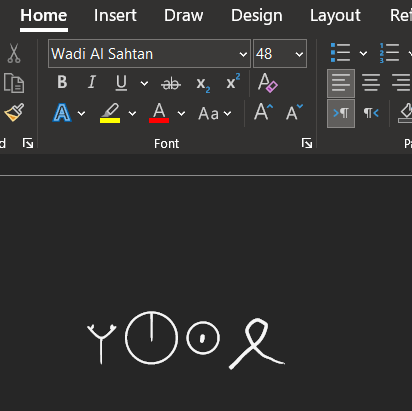
The result is a TrueType font, Wadi Al Sahtan Regular, with each historical character drawn as a glyph and mapped to a keyboard key. The font is digitally signed and distributed with standard TrueType outlines, so it behaves like any other system font once installed.
Installation and use
On Windows the font file is opened and installed through the standard font preview dialog. Once installed it appears in the font list of any application, including word processors, so the ancient alphabet can be typed, resized, coloured, printed, and exported exactly like a conventional typeface.
Why it matters
Encoding a historical script as a font is a small act of digital preservation. It moves the alphabet from static images into living text: it can be written by anyone, reproduced without loss, embedded in documents, and used in teaching or design. The approach generalises to other endangered or archaic scripts that would otherwise remain locked in photographs.
Credit
With thanks to @harithoman. The font and installation notes are available in the Sahtan-alphabet repository.
← Back to all posts